Tuesday, June 18, 2013

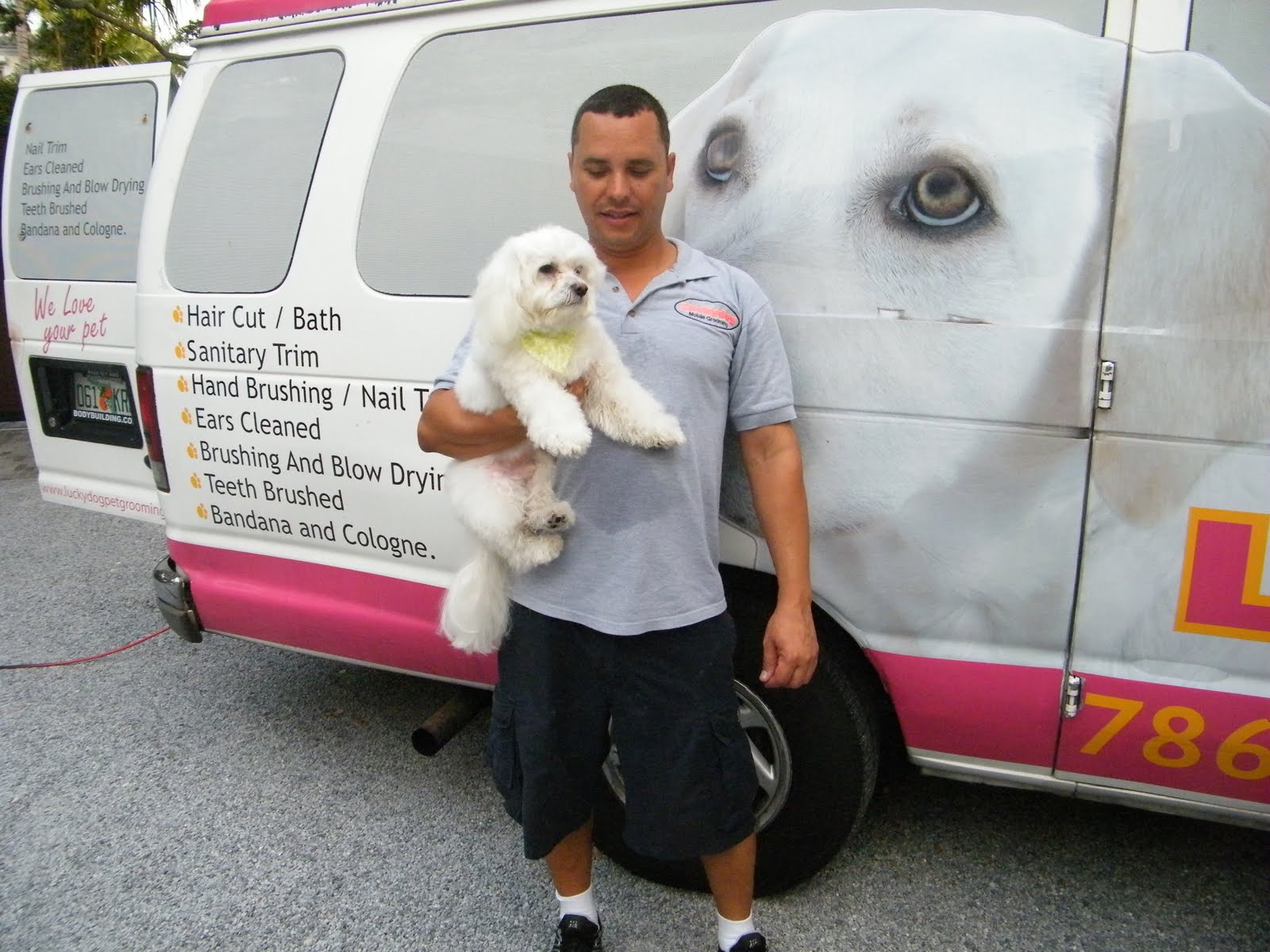
lucky dog mobile pet grooming

keeping a dog healthy and content is neither as easy nor as tought . what it take is an owner is willing to devote the necessary time and energy to exercise ,train ,groom and attend to the other needs of his pet .consciention dog care actually begin before the purchase of the dog ,by realistically evaluating the time one has to spend on a dog ,and opting for a breed whose needs do not outstrip his owner resourses . dont forget that even a well-cared-for healthy dog needs to be examined and vaccinated regularly by a veterinarian . your mobile dog grooming .lucky dog .

Wednesday, February 22, 2012

Mobile Pet GrOOminG miami ! Let us pamper your pets!** 786 487-74-41***

talked to the humane society today ,we are going to donate our time and groom dogs in need ,we love doing good deeds !
having a dog is not cheap ,be willing to put in time & money ,however the reward of their love & companionship is priceless !!

we love it when the costumer are happy & satisfied thank you so much to all my people around the web !

Wednesday, September 14, 2011

911 memorial ground zero dog rescue

NEW YORK CITY (USA) — The post-9/11 recovery will always be remembered for its spirit, its dedication and—to those who know it intimately—its dogs. Wherever you may find yourself today on the anniversary, remember the victims, remember the unity, and remember to say a prayer for the pups.
Revisiting a place they'll never forget,
FEMA US&R Task Force 1 members "Hawk" and Cathy Schiltz take a moment to reflect at Ground Zero in New York, which they haven't seen since last September. Hawk, an Australian Shepherd, never found any survivors, only the remains of dozens of victims. Says Ms. Schiltz: "Sometimes he would look at me as if to say, 'Sorry.' " (Photo: Lauren Hobart / FEMA)
Big dogs (left) and little dogs (below) contributed in big ways.
In a disaster response of unprecedented magnitude, the Federal Emergency Management Agency (FEMA) deployed 25 of its 28 nationwide task forces to the WTC and the Pentagon. In all, there were 80 FEMA-certified dogs at work. The effort was joined by the NYC Police K9 Corps, as well as some 300 search dogs from around the country. And don't make the mistake of overlooking the Port Authority dogs, airport security dogs and therapy dogs who contributed immeasurably.
A wall of red, white and blue honors those killed aboard United Airlines Flight 93 near Shanksville, Pennsylvania, where passengers and crew overpowered the hijackers and sacrificed themselves to avert a much greater disaster, possibly aimed at Capitol Hill or the White House on September 11th, 2001. Yesterday, United Airlines flight attendant Carol Wood, Red Cross Volunteer Patty Dershem, and "Star", a Red Cross dog remembered their loved ones. (Photo: Dan Loh / AP)
These two were not at "the pile", but their sentiments were.
This fantastic photograph, often mistaken for a Ground Zero picture, is not from the WTC but has its own amazing story of human-canine heroics. In 1999, firefighters saved this pregnant Dobie from a house fire in Charlotte. This is how a dog says "thanks." (Humans, don't try this at home.)
(Photo: Patrick Schneider / The Charlotte Observer)
"A fire fighter from Brooklyn approached me since I was wearing a K-9-11 T-shirt provided by a neighbor and fire fighter buddy. The Brooklyn fire fighter asked me if I was a fire fighter. I told him I was a volunteer K-9 handler with Hal Wilson on September 12th at WTC. The guy broke down, telling me how much of a morale booster the dogs were on the pile. 'One came up and licked me, as if to say, I understand how you feel.'

"Then he walked away, teared up, couldn't talk any more. This guy was so big and strong he could lift a car."

Message from Paul Morgan (and "Cody Bear"), Sep. 1, 2002.

Wednesday, September 7, 2011

Ear Infections in Dogs Why Cleaning Your Dog's Ears is Important

Ear Infections in Dogs
Why Cleaning Your Dog's Ears is Important


Cocker Spaniels Prone to Ear Infections
Dog owners who notice head shaking, ear scratching, or tilted head in their pet may be seeing symptoms of ear infection which needs prompt treatment for cure.

Ear infections are quite common in dogs. Although any dog can get an ear infection, breeds such as Cocker Spaniels with heavy pendulous ears and Yorkshire Terriers with lots of hair inside the ears are most susceptible.
Causes


Ear infections are most commonly caused by bacteria, yeast, or mites. Anything that impairs drainage and promotes moisture in the ear such as waxy buildup, dirt, hair mats, growths, or ticks can bring on infection. Sometimes pollen, dust, mold, fleas, and even certain foods can cause irritation within the ear.
Symptoms


Dogs with an ear infection may scratch at the ear, shake their heads excessively or hold their heads tilted, or scoot the side of the heads with the infected ear along the ground or carpet. They may shy away from being petted around the ears. Upon examination, dog owners may find the ear to be red and irritated or filled with dark or yellowish discharge. Often a smelly odor is detected.
Prevention
Regular cleanings with a good ear cleansing solution go a long way toward preventing ear infections. Dogs with hair growing inside the ears will benefit from keeping it clipped.

Tuesday, August 30, 2011

Urgent Plea for Home for Retired Military Dog / UPDATED!


This is such a sad story – makes me wish I didn’t already have a houseful. Rocky served three tours in Iraq between 2004 and 2007. His last handler was killed in action, so Rocky was brought back to the States and has been cared for by other members of the unit. However, now that his back legs are failing, the military will have to put him down unless someone adopts him by August 24th.

From the Pets for Patriots web site:

Like most military working dogs, Rocky is independent, but he has a sweet temperament and enjoys relaxing in the sun. As a result of his disability, he uses a canine wheelchair and needs assistance to do “his business.” He would do best in a family that can devote a lot of time to him, and that has no small children or other animals. As with many military canines, Rocky shows slight dog aggression. More than anything, Rocky needs someone who honors his service, and who will love and accept him.

Rocky’s known medical conditions:

Benign Prostatic Hyperplasia/Enlarged prostate
Mild hip dysplasia L coxofemoral joint, grade I
Bilateral coxofemoral DJD (mild)
Bilateral neurologic defecits rear legs – degenerative myelopathy
Pressure/kennel sores

Come on, folks. This dog worked hard to ensure our freedom. Doesn’t he deserve a loving home (maybe with a vet??? – either kind) to serve out his last days?

If you or someone you know has a big heart for this dog who put his life on the line for our country, please contact Camp Pendleton directly and immediately if you have questions about Rocky:

Spc. Joseph Ramsey: (760) 725-5527; email: joseph.t.ramsey@us.army.mil

Spc. Jade Clarke: (760) 725-5527; email: jade.clarke@us.army.mil

If you’d like to adopt Rocky, please fill out an application online. This will take you to Lackland AFB, which processes all requests for military dog adoptions across the United States armed forces.

Monday, August 29, 2011

Canine Guard for a Navy SEAL Funeral

Don’t you just love this picture? They aren’t lying when they call dogs Man’s Best Friend. This showed up recently on Facebook – made me cry. Here’s the original caption, but I don’t know who took the pic.


During Navy Seal Jon Tumilson’s funeral yesterday, his trusted canine friend Hawkeye guarded him one last time.

Tumilson was one of the SEALs killed in the helicopter crash August 6th in Afghanistan.

To all of you who are serving: Thanks, stay safe, and come home soon! We love each and every one of you.

Your Pet May Predict Your Personality Study Shows 'Dog People' May Be More Outgoing, 'Cat People' More Creative

Sep 30 2010 – you are a "cat person" or a "dog person"? Even people who don't own either pet tend to self-identify as one or the other, and the answer may say something about their personalities, a study shows.
As a rule, dogs are more social and eager to please, while cats are more introverted and curious.
In the new study, self-described cat and dog people appeared to share these traits.

In the new study, self-described cat and dog people appeared to share these traits.
"Even though we have this widely held idea that dog people and cat people are somehow different, we haven't really known how they are different and previous research has failed to tell us," psychologist and study researcher Sam Gosling, PhD, of the University of Texas at Austin, tells WebMD.
He believes this is because earlier studies examined personality differences in cat and dog owners, failing to account for the fact that a dog person may actually own a cat and vice versa.


As part of a larger online personality survey, Gosling and colleague Carson J. Sandy, asked about 4,500 people if they considered themselves dog people or cat people.
The 44-question survey delved into the five dimensions of personality thought to encompass the spectrum of personality types:


• Conscientiousness. Common behaviors include self-discipline, sense of duty, and a tendency toward planned vs. spontaneous behavior.
• Extraversion. Tendency toward being gregarious, enthusiastic, positive, and energetic.
• Agreeableness. Includes attributes such as trust, altruism, kindness, affection, and sociability.
• Openness. Includes traits such as appreciation for the arts, curiosity, creativity, and nontraditional thinking and behavior.
• Neuroticism. Includes characteristics such as being easily stressed, anxious, or easily worried.
"In terms of personalities I would say Woody Allen is at one end of this spectrum and the "Dude" from the Big Lebo ski is at the other," Gosling says.
Forty-six percent of those who took the survey identified themselves as dog people, while 12% said they were cat people. Twenty-eight percent said they were both and 15% said they were neither.
27 Ways Pets Improve Your Health
Cat People vs. Dog People
According to the findings, self-identified dog people were 15% more extroverted, 13% more agreeable and 11% more conscientious than cat people.
Cat people were about 12% more neurotic and 11% more open than dog people.
"These are not huge differences," Gosling says. "There are certainly many, many cat people who are extroverts and many, many dog people who aren't."

But he adds that the findings may have broader implications in the field of pet therapy, suggesting that personality screening may help match people in need with the most appropriate animal.
The study will be published later this year in the journal Anthrozoos.
Film producer Susan Williams, of Atlanta, owns a dog and two cats, but she is firmly entrenched in the canine camp.

"Neither of my cats likes me much because they know I don't get them," she says.
Her 9-year-old daughter, Ella, on the other hand, could probably qualify as a '"cat whisperer."
"Outside the house I rarely see a cat because they know I'm a dog person, but any cat within a block of her will find her."
Williams says she definitely believes dog people, as a rule, are more extroverted and agreeable and that cat people are more introverted.
"I'm a flight, not fight person," she says. "To avoid an argument, I'll agree with you if you tell me the sky is green."
For any other question go to: www.luckydogmobilepetgrooming.com


Sunday, August 28, 2011

Dog shedding is a natural process in canines

Dog shedding is a natural process in canines; however it causes problems for owners: allergies and cleanliness issues. All dogs shed, even if some breeds tend to shed more than others. Dog shedding can be controlled by following a few easy tips.
1. Brushing
Brushing your dog on a regular basis is a great way to manage dog shedding. While brushing, you will be able to remove all the loose fur and the hair won’t end up in your home or on your clothes.
Choose brushes that are suitable for your dog’s coat type and length. Using the wrong type of brush may pull out your dog’s hair and cause injuries.
Short haired dogs need less brushing, while long and wiry coated dogs will need brushing at least once per day.
once per day.
2. Bathing
Bathing is another way to control your dog’s shedding. A clean coat and skin means less shedding. In addition, while bathing your dog, you may also remove the loose hair.
Some breeds require less baths (i.e. once every two months), however most dogs can be bathed on a regular basis.
Dogs need more frequent baths during the summer. You can bathe your dog once per week and this will moisten the dog’s skin and prevent dryness. Dry skin means more shedding. You may also use some gentle shampoos that will nourish the dog’s skin and reduce shedding.
3. Diet
Your dog’s diet can also contribute to the amount of shedding. A dog with a poor diet will shed more. Try to feed your dog a balanced diet rich in protein, fat, fibers and less carbs. Talk to your vet for more dietary recommendations.
4. Supplements
If your dog’s diet is poor in nutrients, some supplements may be required to get a healthy coat and reduce shedding. Fatty oils are important for a healthy coat and a hydrated skin. Fatty acid supplements will provide the necessary nutrients for your dog’s skin and coat and will reduce shedding.

5. Flea and Tick Control
Ticks and fleas and other parasites may cause a lot of uneasiness. Dogs will tend to scratch and this may lead to excessive shedding and even bald patches. Fleas and ticks may be removed with

insecticides and special formula shampoos. Make sure you get rid of all the fleas and ticks in your home to prevent re-infection.
6. Manage Stress
A stressed dog may lose more hair than usual. Stress in dogs may be caused by environmental changes, the loss of someone in the family or a fellow pet, a new baby or a new pet or health conditions. Managing stress may solve the problem and reduce shedding. Identify the source of your pet’s stress and try to handle it with affection, therapy or even medication. Talk to your vet for more options.
If you notice that your dog is shedding excessively, it is a good idea to visit the vet to rule out any medical condition that may cause shedding. Common diseases that cause shedding are: skin problems, the ringworm, mange or cancer. The shedding is abnormal is your dog has bald patches.


Saturday, August 27, 2011

dog your dog dig ?


Does Your Dog Dig?

Dogs dig for all sorts of reasons. Some breeds are more likely to dig than others. Sometimes they dig out of boredom; other times they’re just following the wolf instinct from way back when. No matter what the reason is, it can be a real pain. There are a few, simple things that you can try to alleviate the problem.
1. Sprinkle cayenne pepper into the holes. When your pup returns for more digging fun, he’ll hate the sensation.
2. Some dogs don’t like to get their feet dirty with poop. Drop some of their droppings in the hole, cover it and add some more on top. That part of the yard will soon become free of holes again.
3. If you find your pet digging out of boredom, try to provide another way to stimulate his mind. I find that a peanut butter stuffed Kong toy works wonders.
4. This should go without saying, but…if all else fails, limit his access to the yard.

How to Stop the Constant Barking of Dogs in the Backyard

Few things are more aggravating or nerve-racking than the constant barking of dogs in a residential neighborhood. Here you are trying to work, sleep or just relax, and all you hear are deep, loud woofs or high-pitched yelps. But there are things you can do to solve this common problem; in fact, if you are the dog's owner, it is your responsibility to do so. Otherwise, you may find that you are not the only one who has a problem with the dogs barking --- neighbors might complain, as well.
Instructions
1. 1
Give your dog enough attention. At times, constant barking by a dog left outside alone is just a cry for help. The dog may try to communicate with passers-by or other dogs in a desperate attempt to be noticed. Spending little or no quality time with your pet may exacerbate the problem. Consider getting another dog for it to play with. This provides a cure for boredom and a sense of camaraderie for your pooch.
2. 2
Exercise your dog. Many times, excessive barking occurs because the dog is restless. If getting another dog for yours to play with is not feasible, take your dog on long walks or to the park. A dog park is an especially sound option, as it lets your canine interact with others of its kind. If you exercise it hard enough, when you get home your dog is likely to be too tired to do anything but sleep.
3. 3
Limit the amount of time that your dog spends alone in the backyard. If all else fails, you may simply need to keep your dog in the house more often. This may help solve the barking problem, as there is less stimuli inside to cause your dog to express itself that way. The animal may also feel a sense of comfort and security just being closer to you. At the very least, whatever barking occurs is unlikely to aggravate your neighbors or others outside your home.
Tips & Warnings
• If you are bothered by the backyard barking of a dog that's not yours, try to have a civil conversation with the owner. Make the person aware that the excessive barking is disturbing you, and ask if there's anything you might do to help rectify the situation.
• Only as a last resort should you involve law enforcement. The owner of the dog may be breaking noise ordinances if the barking occurs at certain times of the day or night.